Yearbook: digital or printed?
An honest comparison — including the arguments against the printed book. When a PDF edition is the better decision, and when it isn't.
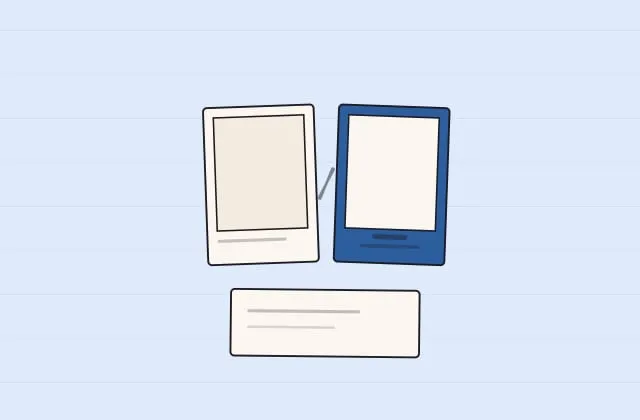
The question usually comes up in February, when it becomes clear what printing costs: “Do we actually have to print this?” It is a fair question, and the answer is less clear-cut than sellers of printed products — us included — like to present it.
So here is the honest comparison, with the points that argue against printing.
What speaks for the printed book
It actually gets kept. That is the only argument that really counts, and it counts a lot. A book is on a parent’s shelf in twenty years. A PDF sits in a downloads folder on a laptop that no longer exists, in a cloud account whose password nobody remembers.
That isn’t a nostalgia argument, it’s a technical one: digital files need active maintenance to survive thirty years. Paper needs a shelf.
It gets looked at together. Books get passed around at the leavers’ ball, the evening everybody is together. A file gets opened alone.
It is a conclusion. A physical object marks an ending in a way a download can’t. That’s why year groups that started out digital often print after all.
Signatures. The underrated point: the last pages are there to be signed in, and those are exactly the pages people read in ten years. Digitally there is no equivalent.
What speaks against the printed book
And now the part that’s missing from advertising copy:
It costs money. €8 to €15 per copy is a real barrier for some people in the year group — and it’s always the same people it’s a barrier for. A PDF edition costs nothing and excludes nobody. If your goal is that everybody has the yearbook, that is a strong argument.
It is final. A mistake in print is a mistake in 120 copies. A mistake in a PDF is fixed as soon as somebody reports it. With names and quotes that matters more than it sounds — see Proofreading.
It has a hard deadline. Printing forces a handover you can’t move. If your year group is running late, a digital book is the difference between “a bit later” and “not at all”.
It can’t do what screens can. No videos, no voice messages, no 400 photos without a page limit. If you want a photo gallery with 800 images, you don’t want a book.
It is a data protection argument in both directions. Printed, a book isn’t searchable and isn’t copyable — that’s an advantage. But it also can’t be pulled back: anyone who decides after printing that they don’t want a photo of themselves in it is out of luck. With a PDF edition you can supply a corrected version. More on that: Data protection in the yearbook.
When digital is the right decision
Honestly, in these cases:
- Very small year groups. At 20 copies the unit price is so high that it becomes the main topic.
- When the money doesn’t stretch otherwise. A digital book everybody has beats a printed one two thirds can afford.
- When you’re very late. In May with no content, a PDF is the rescue, not a compromise.
- As a supplement. Printed for those who want it — plus a PDF edition for everybody. In most cases that is the best answer to the whole question.
The middle way that usually wins
Print small, supplement digitally. That is: set the print run exactly to the paid pre-orders plus a 10 % buffer — and everybody additionally gets the PDF edition.
That gives you both: the object for the people who want it and pay for it, and completeness for the year group. And you have no stock risk, which is the classic mistake: print 150, sell 105, keep 45 in a cellar. How to determine the run properly is in What does a yearbook cost.
Practically it is no extra work: in AbiHive you export a complete, print-ready PDF anyway. The same file is the digital edition — you don’t have to build anything twice. Whoever wants to print hands it to a printer, or orders directly through the built-in print ordering, if your year group uses it.
What you should not do
- Build a “digital yearbook” as a website or app. Sounds modern, costs several times the time, and in five years the link is dead. A PDF is still readable in twenty years; a home-made web app isn’t.
- Put the PDF up publicly on the internet. Profiles, photos and quotes of minors don’t belong in a file anybody can find and search engines index. Distribute it to the year group, not to the internet.
- Do digital and print in two different layouts. Double the work for a result nobody compares.
- Make the decision in May. It affects the page count, image resolution and sponsorship prices. Decide in the autumn, even if only provisionally.
The decision in four questions
- How many copies do we want at minimum? Under 40, printing gets expensive.
- Can everybody in the year group afford the price? If not: supplement digitally.
- Are we on schedule? If not: digital is the realistic option.
- Do we want signature pages? If yes, the question is settled.
Takeaways
- The strongest argument for printing is durability, not nostalgia.
- The strongest argument against is the price, and it always hits the same people.
- The middle way usually wins: print tight, PDF for everybody.
- No home-made web edition, no public download.
- Decide in the autumn, not in May.
If you want to print: Handing over print files properly. If you aren’t sure yet: it changes nothing about collecting the content — start with that, the decision can wait until winter.
More from Organisation

Schedule for a new year group: one school year, twelve stages
When do you start the yearbook, and what is due when? The process across a whole school year — with the dates that follow backwards from the leavers' ball.
Setting up the committee: who does what
How big does a yearbook committee need to be, which roles do you actually need, and how do you stop two people ending up doing everything? Roles, division, handovers.
Handing over to the next year group
Every year a committee starts from zero — even though the knowledge is already in the building. What to pass on, in what form, and the one hour that saves the next year group weeks.