Schedule for a new year group: one school year, twelve stages
When do you start the yearbook, and what is due when? The process across a whole school year — with the dates that follow backwards from the leavers' ball.
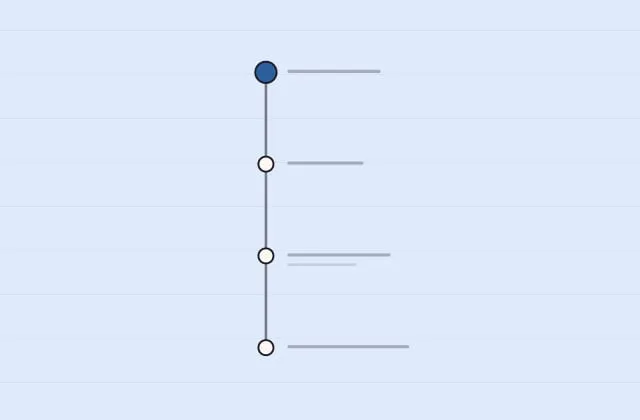
The most common question at the start isn’t “how do we do this?” but “when do we have to start what?”. The answer is uncomfortable: earlier than you think — but with considerably less work per week than you fear.
The reason is simple. Almost everything in a yearbook has to be collected from 60 to 120 people. Collecting doesn’t take as long as it takes for everyone to respond. Start in March and you don’t have a layout problem — you have a response-rate problem, and diligence won’t solve that.
Count backwards, not forwards
Don’t sit down and ask “what do we do first”. Take the one date that is genuinely fixed and count back from it:
- The leavers’ ball — usually set a year in advance.
- Books delivered — 3 to 5 days before. Not the day before: if the delivery is held up, you need room.
- Print handover — depending on the printer, 10 to 20 working days before delivery. Ask them specifically before you can plan. Digital printing is faster than offset.
- Internal deadline — two weeks before the print handover. Those two weeks are for proofreading and the things that always still turn up.
- Content closed — four weeks before the internal deadline. From here on nothing more is collected, only built.
Everything before that is collecting time. With a ball at the end of June, “content closed” lands around the end of March — and the collecting phase has to come before that, not after.
The school year in five phases
September to November — Founding
The committee forms, the motto is chosen, the money is settled. No content is created in this phase, and that’s right: you’re building the structure that carries the collecting later.
- Assemble the committee and share out the tasks — who does what
- Vote on the motto (100 ideas)
- Rough calculation: what does a yearbook cost
- First sponsor enquiries out — finding sponsors
Choosing the motto first has a practical reason: it determines the title, the cover and the colour world. Build the layout before the motto and you build it twice.
December to February — Collecting
The one phase in which the whole year group works, not just the committee. This is where it is decided whether the book fills up.
- Open the profiles (100 questions)
- Run the rankings and polls (100 award ideas)
- Collect quotes and teacher awards
- Collect photos — the part that takes longest
- Distribute the course reports to the courses
Reckon with three rounds of reminders, not one. What genuinely helps is in How to get the year group to take part.
March to April — Building
Now the material becomes a book. That is committee work, not year-group work.
- Fix the page order, choose the templates
- Have the free pages designed (12 examples)
- See the layout through — not looking like Word
- Run the proofing rounds (the process)
May — Handing over
- The last two weeks are a discipline of their own
- Handing over print files properly
- Fix the print run for good: only once the pre-orders are in
June to July — Distributing and passing on
- Distribute the books and settle the accounts — Distributing, selling, leftover copies
- And then the thing almost everybody forgets: Handing over to the next year group
The three dates that really hurt if they slip
Not every date is equally critical. These three drag everything else with them:
| Date | Why it carries | Buffer |
|---|---|---|
| Motto decided | Blocks the cover, the title and every template | 2 weeks |
| Content closed | From here the volume is fixed and the layout plannable | 4 weeks before the internal deadline |
| Print handover | The only date somebody outside sets for you | 10–20 working days before delivery |
Everything else can slip a week without endangering the project. These three can’t.
Why a schedule in your head doesn’t count
A schedule that only exists in the committee chat doesn’t exist for the year group. The 90 people who are meant to deliver never see it — they only see a message in a chat that has scrolled out of sight two days later.
So the dates belong where the content is created. In AbiHive you set a deadline per area (profiles by X, photos by Y) and a handover date for the whole book. That gives you:
- On everyone’s home screen, a countdown to printing.
- Anyone who hasn’t entered anything shortly before a deadline gets an automatic reminder — only the stragglers, not everybody.
- After the deadline the area closes for the year group. The committee still gets in to check and to print.
The effect is banal and still large: a date that lives in the product gets kept. A date that lived in a WhatsApp message gets negotiated.
Takeaways
- Count backwards from the ball, not forwards from today.
- Ask the printer early about their lead time — it’s the one value you can’t set yourselves.
- Put “content closed” four weeks before the internal deadline. Those four weeks are the difference between a finished book and an almost-finished one.
- And start in the autumn, not in the spring. Not because of the work — because of the response time of 90 people.
More on dividing the work: the features at a glance.
More from Organisation
Setting up the committee: who does what
How big does a yearbook committee need to be, which roles do you actually need, and how do you stop two people ending up doing everything? Roles, division, handovers.

Handing over to the next year group
Every year a committee starts from zero — even though the knowledge is already in the building. What to pass on, in what form, and the one hour that saves the next year group weeks.
How to get the year group to take part
“Nobody fills anything in” is the most common problem of any yearbook — and almost always a design problem, not a motivation problem. What actually produces responses.